Windows 11 Runs on 128MB RAM in Extreme Minimalist Experiment
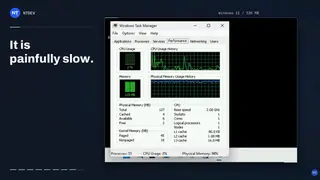
A developer has successfully booted a heavily stripped-down version of Windows 11 26H2 with only 128MB of RAM—just 3.1% of Microsoft’s recommended minimum. The minimal installation allows basic functions like the Desktop, File Explorer, and Notepad to operate, though performance is severely limited. This experiment demonstrates the extreme limits of Windows' hardware requirements through deep system optimization.
In November 2026, developer NTDEV successfully booted a heavily modified version of Windows 11 26H2 on a system with only 128MB of RAM—just 3.1% of Microsoft’s official minimum requirement of 4GB. This experimental build, part of the ongoing Tiny11 project, enabled basic functions such as launching the Desktop, File Explorer, and Notepad, though performance was described as “painfully slow.” The achievement builds on prior work from 2023, when NTDEV previously ran Windows 11 on 176MB of RAM by eliminating drivers, background services, and non-essential components. That earlier version relied on an IDE storage interface to minimize driver load, while this latest iteration pushes the boundary even further, demonstrating how far the operating system can be stripped down. The developer has not disclosed a full technical breakdown of what was removed, but the success hinges on deep system optimization and the use of minimal hardware interfaces.
NTDEV, known for pushing the limits of Windows efficiency, is primarily motivated by technical exploration rather than practical deployment. Their work reflects years of experimentation with lightweight Windows variants, including an earlier project that compressed a full Windows 11 installation into a CD-ROM-sized ISO file (699,811,840 bytes). These efforts are not intended as usable alternatives to standard installations but serve as demonstrations of the OS’s underlying flexibility. Microsoft has made no public response to these experim
This experiment highlights the enduring tension between software bloat and hardware accessibility. While Windows 11’s official requirements demand modern hardware, NTDEV’s work shows that core functionality can persist under extreme constraints, potentially offering insights for low-resource computing environments such as education in developing regions or retro computing projects. The broader impact may be indirect: by showcasing how much of Windows can be stripped away without total collapse, the project could inspire developers to create more modular or configurable operating systems. A comparable precedent is the rise of lightweight Linux distributions like Puppy Linux, which gained traction in similar niche use cases. However, unlike those open-source alternatives, this experiment underscores the inherent limitations of a proprietary OS when pushed beyond its design boundaries. It may also prompt renewed debate about software efficiency and vendor-driven hardware demands. What to