Global Chip Sales Surge 24% in Q3 2026 Amid Strong Year-Over-Year Growth
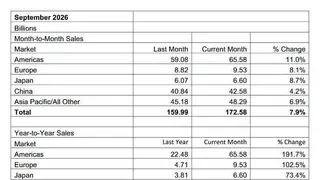
Global semiconductor sales reached $517.7 billion in the third quarter of 2026, marking a 24.1% increase from the previous quarter and continuing a trend of strong growth. September 2026 saw sales jump 146.8% year-over-year to $172.6 billion, with all major regions reporting double-digit gains. The Semiconductor Industry Association attributed the surge to sustained demand across AI, consumer electronics, and industrial applications.
Global semiconductor sales surged to $517.7 billion in Q3 2026, marking a 24.1% increase from the prior quarter and continuing a streak of strong growth for the third consecutive quarter. September 2026 alone saw sales reach $172.6 billion—up 146.8% year-over-year—driven by robust demand across AI infrastructure, consumer electronics, and industrial systems. The Semiconductor Industry Association (SIA), citing data from the World Semiconductor Trade Statistics (WSTS), attributed this momentum to sustained investment in high-performance computing and expanding applications in emerging technologies. Regionally, all major markets reported double-digit year-over-year growth in September, with the Americas leading at 191.7%, followed by Asia Pacific/All Other (141.4%), China (124.9%), Europe (102.5%), and Japan (73.4%). Month-to-month increases were also notable, particularly in the Americas (11.0%) and Europe (8.1%).
This surge follows earlier reports of escalating demand for AI hardware, including NVIDIA’s RTX 5090 GPUs being purchased in bulk by AI firms for server deployment. The same period saw Micron CEO warn of tighter memory supply in 2027–2028, suggesting long-term scarcity concerns. Meanwhile, Chinese firms like YMTC continue to project extended memory shortages through at least 2029, while U.S. policy shifts—such as the removal of CXMT and YMTC from restricted tech lists in February 2026—may have eased supply chain tensions. Key players include NVIDIA, Micron, and Ch
The surge in semiconductor sales reflects a broader transformation in how computing power is being deployed, with AI infrastructure now a dominant driver of demand. This shift could accelerate the digital divide, as nations and companies with access to advanced chips gain disproportionate advantages in innovation and economic output. Consumers may face higher prices for electronics and gaming hardware due to constrained supply, while enterprises relying on cloud-based AI services may see increased costs passed through. The memory shortage outlook, highlighted by Micron and YMTC, suggests that even as demand grows, supply chain bottlenecks could persist into 2028, affecting everything from smartphones to data centers. A comparable precedent is the 2017–2018 chip shortage driven by cryptocurrency mining, which similarly disrupted markets before stabilizing. Today’s situation may follow a similar arc, but with AI scaling faster and more deeply embedded in infrastructure. What to watch for