NVIDIA Unveils DLSS 5 Across Three Major Games with Advanced AI Rendering
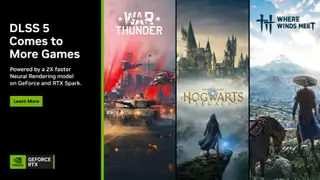
NVIDIA is rolling out its latest DLSS 5 technology to Hogwarts Legacy, War Thunder, and Where Winds Meet, enhancing visual fidelity through AI-driven rendering. The new 3D-Guided Neural Rendering uses game engine data to improve lighting, shadows, and material details without increasing computational load. The update, starting November 5, offers developers fine-grained control over effects while preserving artistic intent.
NVIDIA has rolled out its DLSS 5 technology to three major titles—Hogwarts Legacy, War Thunder, and Where Winds Meet—with the first update launching on November 5, 2026, for Hogwarts Legacy, followed by War Thunder in mid-November, and Where Winds Meet on November 23. The core innovation is 3D-Guided Neural Rendering, which leverages real-time game engine data—including geometry, lighting, and textures—to enhance visual fidelity without increasing computational load. This version reduces the model’s footprint by 24% (to ~118 million parameters), cuts 4K VRAM usage by 20%, and delivers up to 2X higher performance compared to prior versions. The technology is now available on GeForce RTX 50 Series GPUs, RTX Spark systems, and GeForce NOW Ultimate. Benchmarks indicate Hogwarts Legacy can reach 300 FPS at 4K with DLSS 5 enabled, while War Thunder hits 400 FPS under the same conditions. Developers gain fine-grained control via AI models, intensity settings, and semantic masking to preserve artistic intent.
The rollout follows earlier announcements such as the March 2026 unveiling of DLSS 5’s real-time neural rendering capabilities and ongoing development of DLSS 4.5, which has already been integrated into titles like Call of Duty: Modern Warfare 4 and GRAVHOUNDS. NVIDIA’s collaboration with studios—including Avalanche Software on Hogwarts Legacy, Gaijin Entertainment on War Thunder, and Everstone Studio/NetEase Games on Where Winds Meet—highlights a strategic push to embed AI r
The integration of DLSS 5 into major games could significantly shift expectations for visual quality in real-time rendering, especially as AI-driven enhancements become standard. Gamers using high-end hardware may see smoother performance without sacrificing detail, potentially increasing engagement with graphically intensive titles. However, the technology’s reliance on proprietary models and GPU-specific optimizations may widen the gap between high-end and mid-tier systems, raising concerns about accessibility. The broader impact could extend to game development workflows, where studios might prioritize AI-enhanced rendering over traditional asset creation, possibly reducing workload but also limiting creative control if tools become too prescriptive. A comparable precedent is the adoption of ray tracing, which initially required specialized hardware but eventually became a standard expectation in AAA titles. What remains uncertain is whether DLSS 5’s efficiency gains will be matched