ASUS ROG XG Station 3 Debuts with Thunderbolt 5 for High-Performance External GPU Use
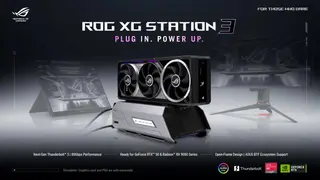
ASUS Republic of Gamers has introduced the ROG XG Station 3, an external GPU dock featuring Thunderbolt 5 support with up to 80 Gbps bandwidth and 120 Gbps with Bandwidth Boost. It enables high-fidelity gaming and content creation when paired with top-tier graphics cards from NVIDIA, AMD, or Intel. The open-frame design enhances cooling and aesthetics, while supporting cable-free BTF 2.5 power delivery and full RGB synchronization via Aura Sync.
ASUS Republic of Gamers (ROG) unveiled the ROG XG Station 3 on November 4, 2026, introducing an external GPU dock that leverages Thunderbolt 5 technology to deliver up to 80 Gbps of bidirectional bandwidth—boostable to 120 Gbps with Bandwidth Boost. This enables high-performance computing for AAA gaming and content creation when paired with top-tier graphics cards from NVIDIA (GeForce RTX 50 Series, RTX PRO 6000 Series), AMD (Radeon RX 9000 Series), or Intel (Arc Series). The device features an open-frame design to maximize cooling and showcase the installed GPU as a visual centerpiece. It supports both standard PCIe cards and newer BTF 2.5 power delivery via a dedicated GC-HPWR slot, allowing cable-free operation with models like the TUF Gaming GeForce RTX 5080 BTF OC Edition or ROG Astral GeForce RTX 5090 BTF Edition. The dock includes full Aura Sync RGB lighting and offers multiple connectivity options: a Thunderbolt 5 upstream port for up to 140W USB Power Delivery, a downstream port supporting up to three 4K displays via daisy chaining, two front-mounted USB 10 Gbps Type-C ports, and extensive display output flexibility.
The development follows earlier concerns about thermal throttling in high-end GPUs—such as the RTX 5090’s power connector melting at 175°C (reported September 2, 2026)—and modders’ efforts to improve cooling via custom wiring (October 3, 2026). These issues underscore the importance of robust thermal and power delivery solutions in high-performance ha
The ROG XG Station 3 could significantly influence how high-performance computing is accessed outside traditional desktops, particularly among mobile professionals and gamers who value portability without sacrificing graphical fidelity. By enabling laptop users to tap into top-tier GPUs via a single cable—handling data, power, and display output—it may reduce the need for dedicated gaming rigs, especially in hybrid work environments. This could shift consumer spending toward modular accessories rather than full systems, potentially disrupting traditional PC sales cycles. The device’s support for daisy-chaining multiple 4K displays also positions it as a compelling hub for content creators, who often rely on multi-monitor setups. A comparable precedent is the early adoption of external GPU enclosures in the mid-2010s, which saw limited success due to latency and bandwidth constraints—Thunderbolt 5’s higher throughput may overcome those earlier limitations. However, widespread adoption h