PsiQuantum Unveils Low-Loss Optical Switch to Boost AI Data Center Performance
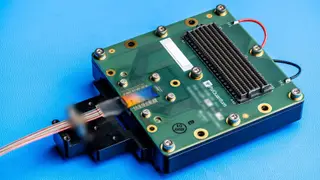
PsiQuantum has developed an 8x8 optical switch using silicon photonics that loses only 1.2 dB of light in lab tests, significantly less than the typical 3 dB tolerance in data centers. The all-optical switch avoids electrical signal conversion, reducing latency and power use in AI GPU networks. The company plans to scale up production for larger devices, aiming to improve data center efficiency for growing AI workloads.
In October 2026, PsiQuantum unveiled an 8x8 optical switch prototype based on silicon photonics that achieves just 1.2 dB of insertion loss in lab tests—significantly below the typical 3 dB tolerance accepted in data centers. The device operates entirely without electrical signal conversion, using a fixed light path maintained through a chip with no moving parts, which reduces both latency and power consumption. While currently limited to eight input/output ports, the company has confirmed that larger-scale versions are in development. This innovation builds on PsiQuantum’s prior work in quantum computing, where minimizing photon loss is critical; their 2025 Nature paper detailed ultra-low-loss components like silicon nitride waveguides (0.5 dB per meter) and near-lossless splitters and crossings. The switch's performance—under 3 ms reconfiguration time and 40 dB crosstalk—exceeds initial targets, though it still lags behind competitors such as Google’s Palomar (136x136 ports) and Lumentum’s R300 (300x300) in scale. Salience Labs and iPronics offer similar low-loss alternatives but rely on built-in amplification, which adds complexity and power draw. PsiQuantum’s approach avoids amplifiers entirely, potentially offering a more scalable solution for AI data centers where GPU-to-GPU communication is becoming a bottleneck.
The broader context lies in the escalating demand for high-bandwidth, low-latency interconnects as AI workloads grow. Traditional copper cabling faces physic
PsiQuantum’s optical switch could significantly impact AI data center efficiency by reducing latency and power consumption in GPU networks, directly benefiting cloud providers and large-scale AI developers. As AI models grow more complex, the bottleneck of inter-GPU communication is becoming a major constraint on performance scaling; this technology may help alleviate that strain. The broader market for optical interconnects is projected to reach $144 billion by 2030, suggesting strong commercial potential. If PsiQuantum’s design proves scalable and manufacturable at scale, it could challenge current leaders relying on MEMS mirrors or amplified silicon photonics, particularly in applications where energy efficiency and low latency are prioritized over sheer port density. A comparable precedent is the shift from copper to fiber optics in the early 2000s—initially niche but eventually transformative for internet infrastructure. However, unlike that transition, this innovation faces hurdl