Intel's Data Center Growth Can't Offset Market Dismay Over Future Outlook
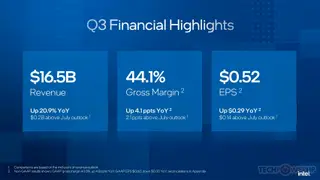
Intel reported strong third-quarter results with a 78% surge in data center and AI revenue, reaching $7.3 billion, and beat earnings expectations. However, the company's weak guidance for Q4—projecting lower revenue and margins—sparked a 29% drop in its stock price, marking its worst day since the 1970s. Analysts cite ongoing PC market declines and rising memory costs as key concerns for future performance.
Intel reported strong third-quarter 2026 financial results, with total revenue reaching $16.5 billion—up 21% year over year—and adjusted earnings per share of $0.52, surpassing analyst expectations of around $0.40. A key driver was a 78% surge in data center and AI revenue, which hit $7.3 billion, highlighting the company’s growing reliance on enterprise and high-performance computing segments. Despite this success, Intel’s guidance for the fourth quarter fell sharply short: projected revenue between $15 billion and $16 billion trailed the consensus estimate of approximately $17 billion, while adjusted EPS was forecast at just $0.25. Gross margins were expected to drop to 38%, down from 44% in Q3. The company cited a plant shutdown in Israel as contributing to the shortfall and confirmed ongoing weakness in the PC market, forecasting a 12% unit decline in 2026 and another 10% drop projected for 2027. Rising memory costs—particularly for DRAM and SSDs—were identified as a major factor squeezing IT budgets and delaying consumer upgrades. The Client Computing Group revenue declined 5% to $8.1 billion, underscoring the broader industry trend of shrinking PC demand, with IDC reporting a 20.1% year-over-year drop in global shipments during Q3. CEO Lip-Bu Tan emphasized the need to increase supply of Xeon chips to meet growing AI and data center demand, while CFO David Zinsner acknowledged the PC slowdown would persist through at least the first half of 2027.
Intel’s sharp stock plunge reflects broader market anxiety about technology sector sustainability amid shifting demand dynamics. While data centers and AI remain growth engines, the persistent decline in PC sales—driven by high memory prices and stagnant consumer spending—threatens to undermine long-term revenue stability for chipmakers. The company’s reliance on enterprise segments may insulate it from some consumer volatility, but it also exposes it to macroeconomic pressures like tighter IT budgets and supply chain constraints. Comparable to the semiconductor downturns of the early 2000s or the 2018 memory glut cycle, this moment could signal a structural shift where AI-driven demand is not enough to offset broader hardware market stagnation. The rising cost of DRAM and SSDs—highlighted by Micron’s warning about tighter supply in 2027—may delay PC refresh cycles and further suppress volume growth. As Intel prepares for another 10% CPU price hike in October, consumers and OEMs may fa