Intel's Data Center Growth Fails to Offset Poor Q4 Outlook, Sending Shares Plunging
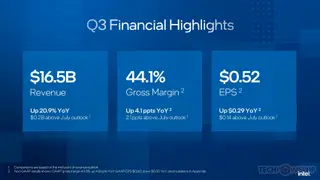
Intel reported strong third-quarter results with $16.5 billion in revenue and a 78% surge in data center and AI revenue, yet its weak Q4 guidance caused shares to drop 29%—the worst single-day decline since the 1970s. The company expects lower-than-anticipated revenue and margins, citing ongoing PC market contraction and rising memory costs. Intel’s leadership anticipates continued PC demand weakness into 2027, with unit sales potentially declining by 12% in 2026 and another 10% in 2027.
Intel reported third-quarter 2026 financial results showing $16.5 billion in revenue, a 21% year-over-year increase, with data center and AI revenue surging 78% to $7.3 billion—driven by strong demand for Xeon processors. Despite this positive quarter, the company issued fourth-quarter guidance that fell significantly short of Wall Street expectations: revenue projected between $15 billion and $16 billion (below the $17 billion consensus), adjusted EPS of just $0.25, and a gross margin decline to 38% from 44% in Q3. These figures triggered a 29% drop in Intel shares on Friday, October 30th, 2026, marking the worst single-day performance since the 1970s, with the stock closing at $65.76 after Thursday’s close of $92.07. The downturn was attributed to ongoing PC market contraction, rising memory costs due to tighter DRAM and SSD supply, and a plant shutdown in Israel. Intel’s leadership, including CEO Lip-Bu Tan, acknowledged that PC unit sales could decline by 12% in 2026 and another 10% in 2027, with the slowdown expected to persist at least through early 2027. The company is now prioritizing supply chain expansion for Xeon chips amid growing AI infrastructure demand.
The broader context includes prior warnings from Micron’s CEO in October 2026 about tighter memory supply in 2027 and 2028, which aligns with Intel’s cost pressures. IDC data confirms a 20.1% year-over-year drop in global PC shipments during Q3 2026, totaling 62.7 million units. This trend reflects a structural
The sharp decline in Intel’s stock and its bleak outlook signal broader instability in the semiconductor industry, particularly affecting consumers, enterprise buyers, and investors. With PC prices expected to remain high due to elevated memory costs—exacerbated by supply constraints—consumers may delay upgrades, further depressing sales and slowing innovation cycles. Enterprises relying on Intel’s Xeon chips for AI infrastructure could face longer lead times or higher costs if supply fails to keep pace with demand. This situation echoes the 2018–2019 semiconductor downturn, when inventory gluts led to price collapses and reduced R&D investment, though today’s challenge is the opposite: scarcity. The ripple effects may extend to PC OEMs, cloud providers, and even software developers who depend on stable hardware availability for performance optimization. Investors may shift capital toward competitors like AMD or NVIDIA, especially if Intel fails to deliver on its AI promises. What to w