Open-Source UEFI Tool Unlocks Hidden AI Performance on Older NVIDIA GPUs Across Windows Platforms
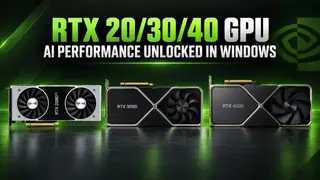
A new open-source tool called NV UEFI Unlocker enables Windows users to access previously restricted Tensor Core performance on RTX 20, 30, and 40 series GPUs by modifying behavior at the UEFI level. Early benchmarks show up to a 75% increase in FP16 compute throughput, with an RTX 2070 achieving 63 TFLOPS and an RTX 4060 Laptop GPU improving from 29.89 to 49.33 TFLOPS. The method avoids permanent firmware changes and works across multiple operating systems.
In October 2026, an open-source tool named NV UEFI Unlocker emerged, enabling Windows users to unlock hidden AI performance on NVIDIA GeForce RTX 20, 30, and 40 series GPUs by modifying GPU behavior at the UEFI level. Developed by GitHub user physicsdolphin, the tool bypasses traditional firmware flashing or driver patching, instead executing changes before the graphics driver initializes—making the unlock temporary and reversible upon power-off. Early benchmarks demonstrated dramatic gains: an RTX 2070 achieved up to 63 TFLOPS in FP16 compute workloads, a 75% increase from its original 36 TFLOPS, while an RTX 4060 Laptop GPU rose from 29.89 to 49.33 TFLOPS—representing a 65% improvement. These results were validated across multiple operating systems, including Windows and Linux, with support confirmed for three generations of RTX GPUs, though GTX 16 Series remain experimental and RTX 50 Series unsupported. The project builds on earlier work by Zagitta, whose Linux-based GPU Unlock tool first revealed that RTX 30 series cards could nearly double their Tensor Core throughput in FP16/BF16 tasks, with real-world AI inference gains of up to 60%.
The tool’s accessibility marks a shift from niche Linux-only modifications to broader Windows adoption. Installation requires a bootable USB with the UEFI application and disables Secure Boot or adds trusted signatures. RTX 20 Series users must also enable GSP firmware mode first. Despite promising benchmarks, results vary by system co
This development could significantly impact the democratization of AI computing by extending usable performance from older GPUs, especially among hobbyists, researchers, and developers with limited budgets. By unlocking latent capabilities without hardware upgrades, users may delay or avoid costly replacements, potentially reducing e-waste and extending device lifespans. The broader market for used GPUs may see renewed interest, as older models become more viable for AI workloads. Comparable to the early days of overclocking, where enthusiasts pushed beyond manufacturer limits, this tool represents a grassroots effort to reclaim performance from proprietary restrictions. However, unlike overclocking, which primarily affects gaming, this unlock targets AI inference and training—domains increasingly central to tech innovation. If widely adopted, it may pressure manufacturers to reconsider how they tier performance across product lines. What remains uncertain is whether NVIDIA will respon