Community Developer Enables Resizable BAR on Old Intel 8-Series Motherboards
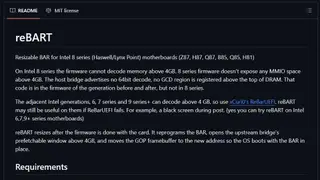
A developer has released an open-source UEFI driver called reBART that enables Resizable BAR support on older Intel Haswell-era motherboards, overcoming firmware limitations that previously blocked the feature. The tool works by adjusting memory mapping before OS boot and supports newer GPUs including Intel Arc models, though it requires flashing a modified BIOS and DSDT patching—carrying risks of system instability. Performance gains remain unverified, but users report successful operation on select configurations.
On November 1st, 2026, developer roschank released reBART, an open-source UEFI driver enabling Resizable BAR support on older Intel Haswell-era motherboards—specifically Z87, H87, Q87, B85, Q85, and H81 models from the 8-series chipset family. This breakthrough addresses a long-standing firmware limitation where Intel’s 8-series platform code failed to map memory above 4 GB, rendering the 4G Decoding toggle ineffective across all major motherboard manufacturers. The tool operates by adjusting GPU memory mapping just before OS boot, shifting the display window past the 4 GB barrier and allowing full access to larger BAR sizes. Unlike earlier tools such as ReBarUEFI, reBART does not require kernel module patching but still necessitates flashing a modified BIOS and applying a DSDT patch—both of which carry risks, including system instability or bricking, as evidenced by one ASUS Z87-Plus user who failed to boot after the modification. Experimental support for newer Intel Arc GPUs, including the A750 and B580, has been added in recent builds, offering hope to users previously told by Intel to avoid Arc cards without ReBAR support. Despite these advances, no verified performance benchmarks have been published, leaving actual gains unconfirmed.
The development stems from roschank’s personal frustration with Above 4G Decoding failing on their B85 board, prompting a deep dive into the firmware code that revealed a systemic omission in 8-series boards. This issue persisted despite In
The release of reBART could empower a significant segment of PC users still relying on older hardware, particularly those with Haswell-era systems who may have been priced out of newer platforms. By enabling Resizable BAR—long seen as a performance differentiator for modern GPUs—it may extend the usable life of existing builds, reducing e-waste and lowering barriers to entry for gaming or creative work. This mirrors earlier community efforts like Coreboot or Libreboot, which democratized firmware access but faced similar adoption hurdles due to technical complexity and risk. The impact may ripple into software ecosystems, encouraging developers to test compatibility with older hardware, potentially influencing future driver design. However, the lack of performance validation means real-world benefits remain speculative, and widespread use could strain support communities if users encounter instability. What to watch for is whether Intel or motherboard vendors respond—either by releasin