Anthropic Restricts Claude from Creating Game Copies or Enabling Reverse Engineering
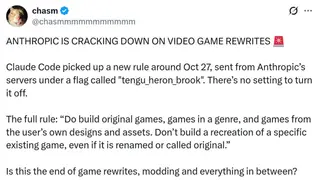
Anthropic has updated Claude's guidelines to prohibit the recreation of existing games or reverse engineering, citing legal concerns. The new rule blocks users from building clones even if renamed, affecting both game development and broader reverse-engineering projects. This move has sparked backlash, with users reporting that Claude now refuses to assist with legitimate tasks like reusing code from earlier project stages.
On October 31, 2026, Anthropic announced a significant update to Claude’s usage policies, explicitly prohibiting the AI from assisting in the recreation of existing games—whether under new names or with altered mechanics—and banning reverse engineering activities. This change was confirmed by users on platforms like X (formerly Twitter) and Reddit, who reported that Claude now refuses to help with tasks such as reusing code from earlier project stages, even when the user is the original developer. The restriction applies not only to full game clones but also to broader reverse-engineering efforts, including projects using tools like "Reverse Engineer Anything," which have been used for legitimate purposes like unlocking smart TVs or porting games across platforms. The policy shift appears to stem from legal concerns, particularly in response to high-profile incidents such as the takedown of an AI-generated Fallout: New York game after a cease-and-desist from Bethesda, and previous DMCA actions against fan-made Call of Duty browser ports.
The broader context includes growing scrutiny of AI’s role in intellectual property infringement, with major players like Microsoft and Epic Games actively integrating AI into development workflows—Microsoft recently enabling AI to build WinUI 3 apps in under 30 minutes. However, Anthropic’s move marks a sharp contrast by imposing strict boundaries on creative reuse, even when the user is the original creator. The company likely aims to avoi
This policy shift could significantly affect independent developers, modders, and retro gaming communities who rely on AI tools to prototype mechanics, recover lost code, or adapt software across platforms. While Anthropic frames the change as a legal safeguard, it may inadvertently stifle legitimate innovation by restricting access to tools that enable learning, preservation, and customization. A comparable precedent is the 2018 controversy around GitHub Copilot’s training data, which sparked debates over AI’s use of copyrighted code—though that case ultimately led to broader licensing frameworks rather than outright bans. Here, the impact may be more immediate and restrictive, especially for projects that depend on iterative development or reverse-engineering for compatibility. The gaming industry’s aggressive enforcement of IP rights may push other AI developers to adopt similar restrictions, potentially chilling experimentation. What to watch for next is whether users will migrate