NVIDIA's Latest GPUs Run Low as Manufacturers Shift to Older RTX 30-Series Models
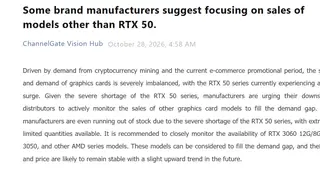
Due to dwindling stock of NVIDIA's GeForce RTX 50-series 'Blackwell' graphics cards, manufacturers in Asia—especially China—are redirecting sales toward the revived RTX 3060 and RTX 3050 models. These older entry-level GPUs, based on the Ampere architecture and produced using Samsung’s 8 nm DUV process, are being pushed to meet demand amid shortages caused by cryptocurrency mining and aggressive e-commerce promotions. Retailers are increasingly favoring these legacy models alongside select AMD SKUs to manage inventory gaps.
In November 2026, Asian GPU manufacturers—particularly in China—are shifting sales focus from NVIDIA’s newly launched GeForce RTX 50-series “Blackwell” cards to older models like the RTX 3060 and RTX 3050, which were originally released during the Ampere generation. These legacy cards, built on Samsung’s 8 nm DUV process, are being revived due to severe inventory shortages of the newer Blackwell GPUs. According to a ChannelGate report, the scarcity stems from aggressive e-commerce promotions and high demand driven by cryptocurrency mining in China, which have rapidly depleted stock across retailers. The RTX 3060 12 GB variant, reintroduced in June 2026, features 3,584 CUDA cores and 12 GB of GDDR6 memory—specifications that remain competitive for entry-level gaming and productivity tasks. Retailers are now actively pushing these older models alongside select AMD Radeon SKUs to manage supply gaps, despite the RTX 50-series being marketed as next-generation.
The shift reflects prior decisions by NVIDIA, including the discontinuation of the RTX 5070 Ti in January 2026 and the rumored end of the RTX 5090’s production in October 2026, with its high-end silicon being reserved for workstation GPUs. These moves suggest a strategic reallocation of scarce silicon, possibly due to manufacturing constraints or demand from AI-driven markets. The broader context includes earlier leaks predicting extreme pricing—such as $5,000 for the RTX 5090 in 2026—and reports of power delivery failur
The resurgence of older GPUs like the RTX 3060 and 3050 could signal a broader trend where high-demand tech products face supply constraints due to concentrated use cases—such as crypto mining or AI workloads—draining new inventory. This may disproportionately affect casual gamers and budget-conscious consumers who rely on predictable availability and pricing, potentially pushing them toward older hardware or AMD alternatives. The second-order effect could be a slowdown in consumer adoption of cutting-edge features like real-time neural rendering (DLSS 5), as demand shifts to more accessible options. A comparable case is the 2017–2018 GPU shortage driven by cryptocurrency mining, which similarly led to inflated prices and a revival of older models. What may unfold next is increased market fragmentation, with NVIDIA balancing high-end AI silicon against consumer demand, possibly leading to longer product lifecycles for mid-tier cards or deeper partnerships with OEMs to manage inventory.